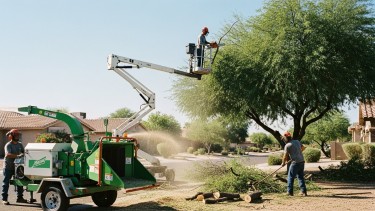
We specialize in professional tree care for Queen Creek's desert community. Our Tree Trimming in Queen Creek, AZ reduces fire risk through expert juniper management and desert-fire resistant pruning. Top Leaf Tree Service offer a full range of services including stump grinding.
We combine crown thinning, deadwood removal, and ISA-certified expertise to enhance drought resilience and safer wildfire buffers.
Pre-Monsoon Juniper Pruning Protocol
Prune junipers 4-6 weeks before monsoon onset to reduce windthrow susceptibility and improve crown aerodynamics. Strategic canopy thinning decreases wind load while maintaining structural integrity through proper branch collar cuts that minimize pathogenic entry points.
Critical Variables:
-
Crown-to-root ratio optimization for anchorage stability
-
Removal of codominant stems and crossing branches
-
Reduction cuts (25-30% maximum per season) to preserve apical dominance
Post-Pruning Intervention:
Deep-root fertilization enhances xylem water transport and strengthens secondary growth supporting newly exposed branch tissues.
Monitoring protocols should assess collar callus formation and evidence of compartmentalization response within 8-12 weeks post-pruning. Proper pruning techniques are crucial for tree health in desert areas, ensuring that trees remain resilient in harsh climates.
Licensed arborists execute ANSI A300 compliance standards, ensuring decay prevention and wind resistance enhancement through evidence-based techniques rather than aesthetic-focused approaches.
Desert-Fire Resistant Trimming Protocol
Effective wildfire mitigation through arboricultural practices reduces fuel load and crown fire transmission risk in arid environments.
Strategic canopy architecture—achieved via crown thinning, dead wood removal, and selective branch elimination—decreases surface-to-crown fire ladder continuity while maintaining photosynthetic capacity.
Core Interventions
Structural Pruning: Elevate live crown base, reduce branch diameter clustering, and eliminate codominant stems susceptible to stress-induced failure during thermal events.
Phytosanitary Assessment: Early detection of drought-stressed tissue, bark beetle colonization, and fungal pathogens prevents rapid crown deterioration and combustibility increase.
Mechanical Support Systems: Tree bracing stabilizes biomechanically compromised specimens, reducing post-fire collapse probability in heat-stressed root zones.
Removal Protocol: Non-viable specimens near structures require systematic extraction to eliminate ignition vectors and falling hazard during wildfire proximity events.
Local Climate-Aware Trimming
Phoenix Valley arboriculture requires seasonal threshold calibration responding to monsoon precipitation cycles, high-temperature desiccation stress (exceeding 115°F), and Santa Ana wind loading patterns.
Evidence-based pruning specifications protect utility clearance compliance, structural integrity, and vascular cambium health.
Technical Framework:
-
High-voltage line clearance: ANSI A300 distance protocols
-
Monsoon preparation: crown thinning reducing wind sail effect
-
Storm damage assessment: failure mechanics in brittle wood conditions
-
Arboricultural certification: ISA standards documentation for insurance subrogation
Get Your Free Tree Trimming Estimate Today!
Top Leaf Tree Service provides arborist-led fertilization programs addressing nutrient deficiencies, soil pH optimization, and root system development.
Core Services:
-
Soil analysis and amendment stratification
-
Macro and micronutrient supplementation
-
Integrated pest management through canopy health protocols
-
Structural pruning for biomechanical stability
Fertilization plans strengthen phloem translocation, enhancing drought resilience and disease resistance. Evidence-based scheduling aligns with phenological cycles and seasonal growth patterns.
Contact Details:
480-933-2909 | office@topleafaz.com | Use our contact form here!
Schedule your complimentary arboricultural evaluation to establish baseline canopy health metrics and customized intervention strategies. Check customer reviews here.
Queen Creek, AZ Attractions and Landmarks
Queen Creek's geographic positioning within the Sonoran Desert creates distinct recreational and educational opportunities.
State parks feature native riparian corridors and bajada ecosystems supporting endemic flora species adaptation to arid conditions. Heritage sites document Apache settlement patterns and territorial water management systems predating contemporary infrastructure.
The region's increasing interface between developed areas and native vegetation necessitates specialized tree maintenance protocols.
Crown pruning reduces wind load on species like palo verde and ironwood, critical for fire mitigation in high-risk zones. Strategic branch removal addresses deadwood accumulation—a primary fuel load factor in Sonoran fire regimes.
Get Started
Fill out form below