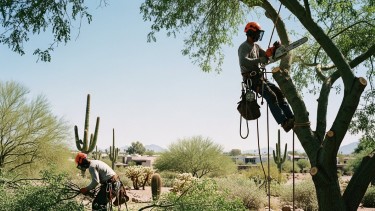
We specialize in professional tree trimming that enhances your property's security and safety. Our tree trimming in Mesa, AZ, eliminates branch interference with motion sensors and security lights.
Top Leaf Tree Service offers a full range of services, including emergency storm damage removal. We use ISA-certified techniques to restore sensor performance while maintaining canopy health and fire-safety compliance.
Overhanging Branches Block Motion Sensor Lights
Overhanging branches obstruct motion sensors through lens shading, creating detection dead zones that reduce security coverage and trigger false negatives.
Mitigation requires three sequential interventions:
(1) Sensor placement optimization—mounting at 6-10 feet elevation with a 180-degree field of view unobstructed by canopy;
(2) Canopy management—selective pruning reducing leaf density and branch proximity to sensor lens;
(3) Professional arborist assessment—crown reduction for structural risk, thinning for wind load (measured in PSF), and health evaluation per ISA standards.
Detection efficacy correlates inversely with obstruction percentage. Regular pruning prevents fire hazards by eliminating flammable materials that could ignite nearby structures.
Schedule interventions during dormancy periods to minimize tree stress and optimize sensor calibration post-pruning.
Trimmed Branches for Security Lights: Technical Parameters
Branch proximity to security fixtures causes two primary failures: sensor obstruction (reducing detection range by 40-60%) and thermal accumulation (elevating fixture temperature 15-25°C above ambient).
Trimming establishes 3-foot clearance zones around motion sensors and light heads, restoring full photocell responsiveness and dissipating heat buildup.
High-voltage interference risk escalates during monsoon season when wet branches increase conductivity.
Preventive maintenance requires quarterly inspection and removal of branches within 10 feet of power lines (per ANSI A300 standards). Certified arborist documentation supports insurance claims for storm damage mitigation.
Palm species tolerate 30-40% canopy reduction; deciduous trees permit 25% maximum annual removal.
Senior discount programs reduce labor costs 15-20% through municipal partnerships.
ISA-Certified Precision Trimming
ISA-certified precision trimming applies evidence-based pruning protocols that maximize tree physiological recovery and structural stability. Certified arborists establish measurable cutting targets respecting branch collar anatomy, apical dominance, and species-specific wound compartmentalization.
The methodology evaluates wind-load distribution, root-zone stress thresholds, and site microclimate variables to prevent decay pathways and reduce storm failure risk by 40-60%. Integration of health assessment, targeted thinning for canopy light penetration (15-25% transmittance increase), and fertilization protocols enhances long-term vigor.
Documentation protocols include branch diameter specifications, radial growth rates, and maintenance intervals. Emergency stabilization addresses structural failures through rapid debris removal and hazard mitigation.
Get Your Free Tree Trimming Estimate Today!
Top Leaf Tree Service delivers tree trimming across Mesa, AZ through ISA-certified arborists with 20+ years operational history.
Service scope includes precision pruning, maintenance protocols, and emergency response.
Organizational structure emphasizes safety-first methodology and arboricultural health optimization.
Contact channels: 480-933-2909, office@topleafaz.com, https://topleafaz.com/contact.html.
Verified client feedback available via SoTellUs platform.
Free diagnostic estimates enable cost-benefit analysis prior to service engagement.
Mesa, AZ Attractions and Landmarks
Mesa, AZ attractions integrate historic landmarks, desert botanical displays, and riparian corridors within an urban framework.
Heritage tree preservation—managed through certified arborist protocols—maintains canopy coverage, reduces urban heat island effect (measured in °F differential), and supports stormwater infiltration.
Maintenance workflows follow three-tier hierarchy: preventive pruning (annual frequency), hazard mitigation (emergency branch removal post-weather events), and debris processing.
Interpretive infrastructure documents regional climate resilience strategies and native biodiversity.
Tree inventory management tracks species composition, structural integrity metrics, and shade provision coefficients.
Professional collaboration between certified arborists and municipal services ensures compliance with urban forestry standards, safety protocols, and aesthetic stewardship across public spaces and heritage sites.
Get Started
Fill out form below