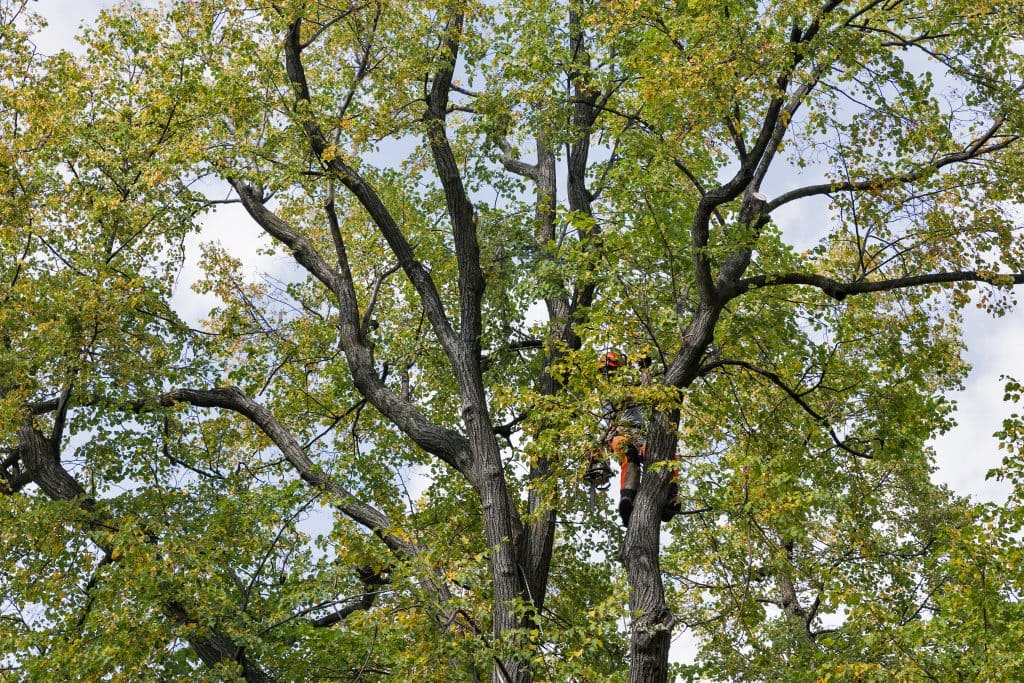
We reduce wildfire risk in Tempe's dry desert climate through strategic tree management. Our tree trimming in Tempe, AZ, eliminates overgrown brush and excess canopy density near structures. Top Leaf Tree Service offers a full range of services, including stump grinding.
We utilize structural pruning and crown thinning to minimize ember transport and enhance airflow, with ISA-certified arborists conducting comprehensive safety assessments.
Overgrown Brush Near Structures: Risk Mitigation
Unmanaged vegetation adjacent to structures creates compounding failure vectors: restricted airflow promotes fungal decay and structural moisture accumulation, while dense canopy loading increases wind-shear stress during severe weather events.
Pest habitat proliferation within overgrown brush establishes pathways for wood-boring insects that compromise load-bearing elements.
Remediation Protocol:
Selective crown thinning reduces wind resistance and improves air circulation around foundations.
Systematic deadwooding eliminates disease vectors and structural liabilities.
Strategic branch removal minimizes canopy contact with roof planes and siding, reducing damage probability during high-wind episodes.
Assessment Criteria:
Licensed arborists evaluate branch-to-structure clearance distances, assess canopy density ratios, and identify species-specific disease susceptibility. Regular tree pruning is essential for safety on commercial properties, as it helps mitigate risks associated with overgrown brush.
Proactive pruning cycles interrupt pest reproduction cycles and fire fuel accumulation.
This integrated approach addresses structural integrity, vegetation health, and property resilience simultaneously.
First-Principles Trimming Protocol
Structural pruning begins with cambial assessment to optimize carbohydrate translocation and apical dominance patterns.
Crown reduction targets wind load distribution across branch unions, reducing bending moments during high-velocity events.
Canopy thinning increases air penetration, decreasing crown sail area while maintaining photosynthetic capacity through selective lateral branch retention.
Assessment Framework:
-
Cambial zone mapping determines dormancy-phase cutting windows
-
Wind-load modeling informs reduction percentages per scaffold limb
-
Shoot-root ratio analysis guides intensity to prevent hydraulic stress
Maintenance Outcomes:
Measurable structural integrity through branch angle optimization, long-term vigor via resource allocation efficiency, and fire risk reduction through fuel load diminishment.
Certified arborist protocols establish baseline vigor metrics pre-treatment and post-treatment compartmentalization responses, ensuring monsoon-season resilience through evidence-based intervention timing.
Isa-Certified Arborists Guarantee Safety
ISA-Certified arborists execute evidence-based interventions across tree care operations. Structural assessments quantify branch load dynamics and failure probability, informing selective pruning, cabling systems, and bracing protocols aligned with ANSI A300 standards.
Risk stratification identifies hazard trees requiring removal or mitigation—critical for high-voltage line clearance, storm damage response, and emergency extraction. Load analysis determines cable placement efficacy and limb retention viability. Stump grinding specifications address root system pathology and site preparation.
24-hour hazardous tree removal manages acute structural failure scenarios.
Get Your Free Tree Trimming Estimate Today!
Top Leaf Tree Service maintains documented customer feedback across third-party platforms. Review aggregation sites provide transparent performance metrics, including service quality assessments, arboricultural technique evaluation, and project completion documentation.
Independent review platforms apply verification protocols to distinguish authentic service experiences from unsubstantiated claims, strengthening credibility markers.
Prospective clients can assess technical competency through detailed project descriptions, equipment specifications mentioned in reviews, and ISA certification credentials referenced by satisfied customers.
Tempe, AZ Attractions and Cultural Landmarks
Tempe's attractions integrate Arizona State University infrastructure with xeric landscape management and public green spaces. Urban arboricultural design prioritizes canopy density for microclimate regulation and solar radiation mitigation in desert environments.
Arboricultural Infrastructure
Tree health maintenance encompasses structural pruning for branch load distribution, crown thinning to reduce wind resistance during monsoon events, and deep-root fertilization protocols addressing alkaline soil composition.
Storm damage remediation includes emergency branch removal and phytosanitary assessment following weather events. Fire risk mitigation strategies employ selective thinning in interface zones, reducing fuel load while maintaining aesthetic function.
Get Started
Fill out form below