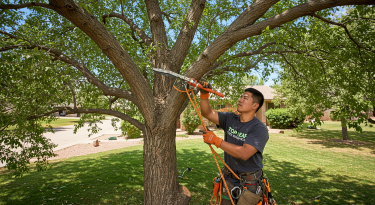
We specialize in removing crossed branches in citrus varieties using proven protocols. Our tree pruning in Gilbert, AZ, addresses codominant stems and vigor disparities across canopy zones.
Top Leaf Tree Service offers a full range of services, including tree trimming to reduce breakage risk and improve light penetration. We maintain proper branch spacing and execute precise 45-degree angle cuts for optimal compartmentalization.
Unhealthy Branch Alignment: Structural Compromise and Mitigation
Branch misalignment indicates codominant stems, mechanical stress, or vascular occlusion. Early detection of crossing limbs and weak branch unions prevents structural failure and pathogen entry points.
Diagnostic Assessment:
Examine vigor differentials across canopy zones—unbalanced apical dominance signals competing growth patterns.
Inspect collar integrity; absence of branch bark ridges indicates poor attachment angles (ideally 45-60°).
Intervention Protocol:
Remove subordinate limbs before secondary thickening obscures anatomical relationships.
Prune during dormancy to minimize compartmentalization stress.
Avoid flush cuts; retain branch collar tissue for optimal wound closure and CODIT (Compartmentalization of Decay in Trees) response.
Post-Pruning Management:
Balanced nitrogen application supports recovery without excessive shoot elongation.
Monitor collar callusing and monitor for canker formation, indicating incomplete wound compartmentalization. Regular tree pruning is essential for safety on commercial properties, ensuring a healthy landscape and reducing potential hazards.
Citrus Crossing-Prune Protocol Perfected
Structural Optimization: Remove codominant shoots at branch unions exceeding 60-degree angles to reduce mechanical stress concentration.
Acute-angle junctions create leverage points vulnerable to wind shear and monsoon loading.
Crown Architecture: Thin internal convergence zones to improve light penetration and air circulation, reducing fungal pressure.
Maintain radial branch spacing (minimum 15cm intervals) to distribute canopy load evenly.
Pruning Mechanics: Execute cuts at 45-degree angles, 5mm beyond branch collar, to promote compartmentalization and minimize pathogen entry.
Remove competing lateral growth competing for apical dominance.
Seasonal Timing: Perform primary pruning pre-monsoon to allow wound closure before high-humidity stress periods.
Secondary thinning post-harvest optimizes next-season productivity without compromising structural integrity.
Certified Citrus Pruning: Physiological Framework and Arboricultural Protocol
ISA-certified arborists apply evidence-based pruning methodology to Citrus sinensis and related taxa, addressing cultivar-specific phenology and apical dominance patterns.
Diagnostic assessment identifies nutritional deficiencies, pathogenic infection, and structural imbalance affecting reproductive capacity.
Key Technical Interventions:
Crown architecture refinement optimizes light penetration and air circulation, reducing fungal pressure while maintaining photosynthetic surface.
Reduction pruning targets excessive vegetative growth, redirecting carbohydrate allocation toward flowering and fruit set.
Transplantation protocols minimize root disturbance and establishment stress through proper field technique.
Physiological Outcomes:
Nutrient distribution follows demand-based allocation patterns—nitrogen supports canopy vigor, phosphorus and potassium enhance fruit quality.

Get Your Free Professional Tree Care & Pruning Services Estimate Today!
Top Leaf Tree Service provides ISA-certified arborist expertise in crown thinning, structural pruning, and risk assessment.
Service Scope:
-
Hazard mitigation through dead wood removal and weight redistribution
-
Canopy management improving light penetration and air circulation
-
Root-to-crown balance assessment preventing decline and storm damage
Why Certified Expertise Matters:
ISA certification ensures knowledge of phytopathology, biomechanics, and species-specific physiology.
Improper techniques compromise vascular systems and create disease pathways—certified protocols prevent these failures.
Contact us: 480-933-2909 or office@topleafaz.com for free estimates.
Use our online contact form!
View customer credentials.
Gilbert, AZ Attractions Desert Arboriculture & Urban Forestry
Gilbert's Sonoran landscape demands specialized tree management addressing arid-climate physiology. Palm species require periodic frond removal and mineral supplementation accounting for alkaline soil pH (7.5-8.5).
Native mesquite and acacia trees demonstrate drought tolerance but need selective pruning to maintain structural integrity and urban canopy distribution.
Critical maintenance protocols: Storm damage assessments must evaluate wind-load capacity in monsoon seasons (June-September).
For residential canopy management to work, fertilization schedules must be tailored to each species and include iron chelation to prevent chlorosis.
Get Started
Fill out form below