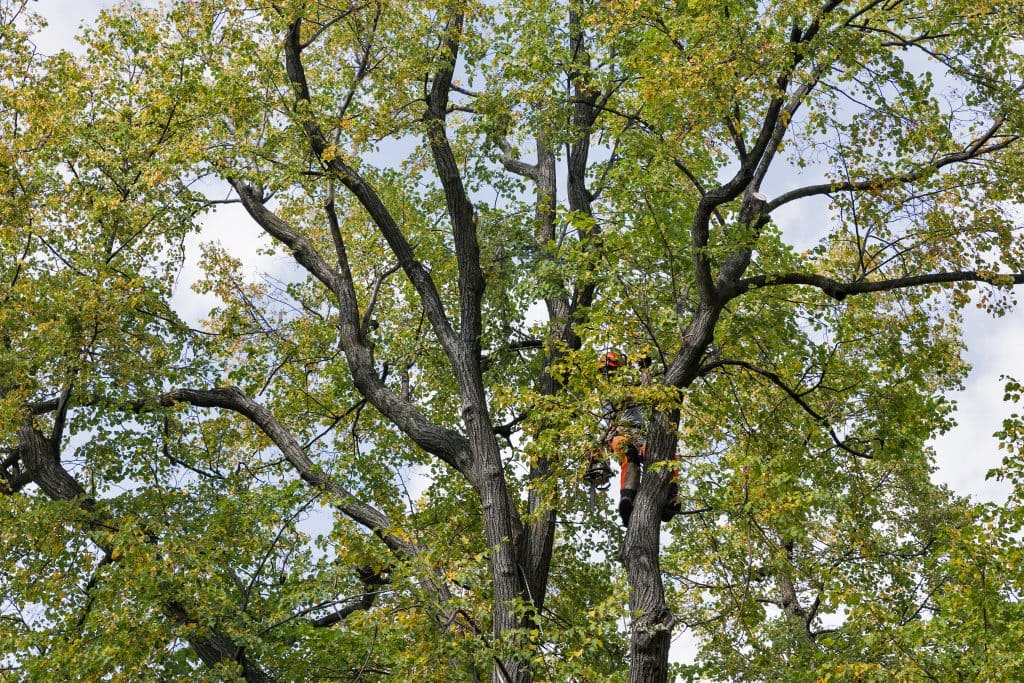
We specialize in preventing interference with neighboring properties through expert tree care. Our tree pruning in Gilbert, AZ, focuses on managing overhanging branches that pose structural and liability risks.
Top Leaf Tree Service offers a full range of services, including tree planting, along with ANSI A300 standards and ISA-certified assessments to ensure safety and property protection.
Overhanging Branches Structural Assessment and Clearance Management
Overhanging branches create compound hazards: canopy weight distribution affecting fence structural integrity, reduced sightlines compromising property access, and accelerated debris accumulation requiring frequent maintenance cycles.
Critical assessment parameters:
-
Limb diameter-to-attachment-point ratio determines failure load thresholds.
-
Crown density affects wind resistance and precipitation shedding.
-
Species-specific growth rates influence pruning interval timing.
Technical considerations:
Crown thinning reduces drag forces during wind events while maintaining photosynthetic capacity.
Lateral branch removal improves clearance without triggering apical dominance response.
Structural pruning at branch collars preserves compartmentalization mechanisms.
Implementation approach:
Certified arborist evaluation establishes baseline health metrics before intervention.
Pruning schedules align with species phenology and local wind season timing.
Licensed contractors ensure compliance with Arizona state arboriculture standards.
Quantified benefits include reduced storm damage probability, maintained fence serviceability, and preserved emergency access routes. Additionally, regular pruning plays a vital role in preventing fire hazards by eliminating flammable materials.
Prune to Clear Neighbor Line
Boundary encroachment pruning removes branches crossing property lines while maintaining crown architecture and apical dominance. This objective requires understanding species-specific branching patterns, growth angle mechanics, and wound compartmentalization protocols.
Technical specifications:
-
Crown reduction cuts positioned at branch collars to optimize CODIT (compartmentalization of decay in trees)
-
Sight-line clearance from structures via lateral branch removal
-
Clearance certification for utility lines (minimum 10-foot setbacks per ANSI A300 standards)
-
Structural assessment identifying codominant stems and included bark hazards
Precise pruning timing aligns with dormancy windows and phenological cycles.
Licensed arborist documentation establishes liability protection and confirms ISA pruning standards compliance, essential for insurance claim substantiation.
ISA-Certified Arborists: Neighbor-Safe Urban Forestry
ISA-certified arborists mitigate property conflict through evidence-based tree management protocols. Systematic risk assessment identifies structural defects, codominant stems, and branch failure mechanics before hazard materialization.
Pruning interventions follow ANSI A300 standards, maintaining apical dominance while establishing safe clearance zones from structures and utility corridors.
Core technical competencies:
-
Crown architecture assessment and corrective pruning
-
Hazard tree evaluation and removal protocols
-
Soil amendment and fertilization diagnostics
-
Boundary compliance documentation
Integrated planning reduces liability exposure during routine maintenance and storm response.
Post-intervention monitoring ensures compartmentalization and canopy resilience while preserving sight lines and property access.

Get Your Free Tree Pruning and Monsoon Cleanup Assessment Today!
Post-storm arboriculture requires systematic evaluation of structural integrity, branch failure patterns, and disease vectors introduced by moisture stress.
Technical Services:
-
Biomechanical failure assessment post-weather events
-
Pathogenic infection mitigation in compromised specimens
-
Stump removal using grinding technology to eliminate regrowth
-
Crown restoration balancing aesthetic form with physiological recovery
Service Area: Gilbert, Phoenix, Paradise Valley
A complimentary safety evaluation quantifies risk thresholds and treatment protocols. Priority scheduling accommodates seasonal demand cycles during peak monsoon recovery periods.
Contact: 480-933-2909 | office@topleafaz.com | Contact us today for your free estimate
Gilbert, Arizona: Urban Heritage and Environmental Infrastructure
Gilbert integrates preserved historic districts with contemporary municipal services supporting public safety and ecological resilience. The urban landscape features botanical parks emphasizing xeriscaping principles and native desert species cultivation. Cultural institutions and historical sites form the downtown core, accessible through pedestrian infrastructure.
Environmental management systems address monsoon precipitation patterns through debris mitigation, arboricultural maintenance protocols, and vegetation health management. Emergency services integration with specialized tree removal operations and palm species management reduces storm-related hazards.
Get Started
Fill out form below