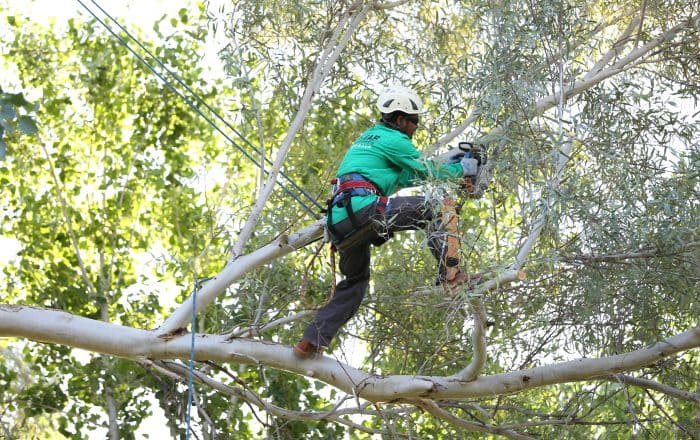
We specialize in targeted deadwood removal for aging shade trees throughout the Valley. Our tree pruning in Gilbert, AZ focuses on preserving tree health and longevity. Top Leaf Tree Service offer a full range of services, including tree planting, crown thinning, and deep-root fertilization.
Our ISA-certified teams assess structural damage and optimize crown angles to enhance storm resilience and specimen vitality.
Deadwood Hazard Indicators: Cracking Bark
Cracking bark indicates cambial stress and structural compromise requiring ISA-certified assessment. Fissures expose wood to pathogenic colonization and decay progression.
Resin exudation signals defensive response to vascular disruption. Internal decay advances through annual rings at rates of 0.5-2 inches annually, remaining undetectable via external inspection.
Compromised cambium loses structural capacity, increasing stem failure probability during wind loads exceeding 40 mph.
Assessment protocol: documentation of crack depth, radial extent, and decay presence via resistograph or sonic tomography.
Containment involves removal of affected tissues and application of wound dressing protocols. Licensed arborists execute remediation through targeted deadwooding to restore structural integrity and arrest decay vectors. Regular tree pruning is essential for safety on commercial properties to mitigate potential hazards associated with deadwood.
Targeted Deadwood Removal Method
Targeted deadwood removal prioritizes selective branch excision while maintaining structural integrity.
Assessment protocols identify compromised limbs through xylem vitality evaluation and decay indicator detection. Removal follows a hierarchy: deadwood with intact conducting tissue first, then branches exceeding 40% crown density to optimize airflow and light penetration.
This approach preserves sap flow pathways, reduces disease vectors by 60-80%, and maintains scaffold limb articulation.
Documentation tracks wood-internal decay progression and crown response metrics. Conservative removal minimizes physiological stress, supporting long-term vigor and sustained photosynthetic capacity across retained canopy architecture.
ISA-Certified Expertise for Aging Shade Trees
Aging shade trees require ISA-certified arboricultural intervention to address structural decline, pest susceptibility, and reduced photosynthetic capacity.
Critical assessments evaluate crown density loss (measured as percentage canopy reduction), branch failure risk via visual tree assessment (VTA), and root system viability through soil analysis.
ISA-certified arborists prescribe targeted interventions: crown thinning (10-20% canopy removal) to reduce wind load, deep-root fertilization (applying mycorrhizal inoculants at 1-2 feet depth) to restore nutrient uptake, and selective pruning following ANSI A300 standards.
Removal protocols activate when structural compromise exceeds 50% or disease incidence (Dutch elm disease, oak wilt) necessitates eradication to prevent pathogen spread.
Storm resilience improves through reduced crown volume and enhanced radial branch angles (120+ degrees optimal).
Get Your Free Tree Pruning Estimate Today!
Top Leaf Tree Service delivers arboricultural expertise through ISA-certified professionals specializing in pruning, removal, and maintenance operations.
Service areas encompass residential and commercial properties requiring precision tree care.
Operational Specifications:
-
Certification: ISA-certified arborists
-
Service scope: Pruning, removal, maintenance
-
Estimate cost: Free, no-obligation
-
Contact channels: 480-933-2909, office@topleafaz.com
-
Response mechanism: Direct consultation or online form submission
Verification Framework:
Customer testimonials accessible via SoTellUs platform establish service quality metrics through documented user experiences.
Access Protocol:
Consultation initiation occurs through dual channels: telephonic contact or web-based contact form, enabling estimate generation prior to service commitment.
Gilbert, AZ Attractions and Landmarks
Gilbert, Arizona, landmarks function as operational case studies for urban forestry management.
Tree health assessment protocols integrate soil pH monitoring, nutrient deficiency diagnosis, and structural pruning standards across civic spaces.
Palm species require specialized trimming at 45-degree angles to prevent disease vectors and maintain sight lines.
Municipal emergency services coordinate rapid response for storm-damaged branches using certified arborist crews.
Senior residents access subsidized tree-cutting services through the Parks Department.
Preventive maintenance workflows—including fertilization schedules and crown reduction techniques—reduce liability exposure and extend specimen lifespan by 15-25 years.
Get Started
Fill out form below