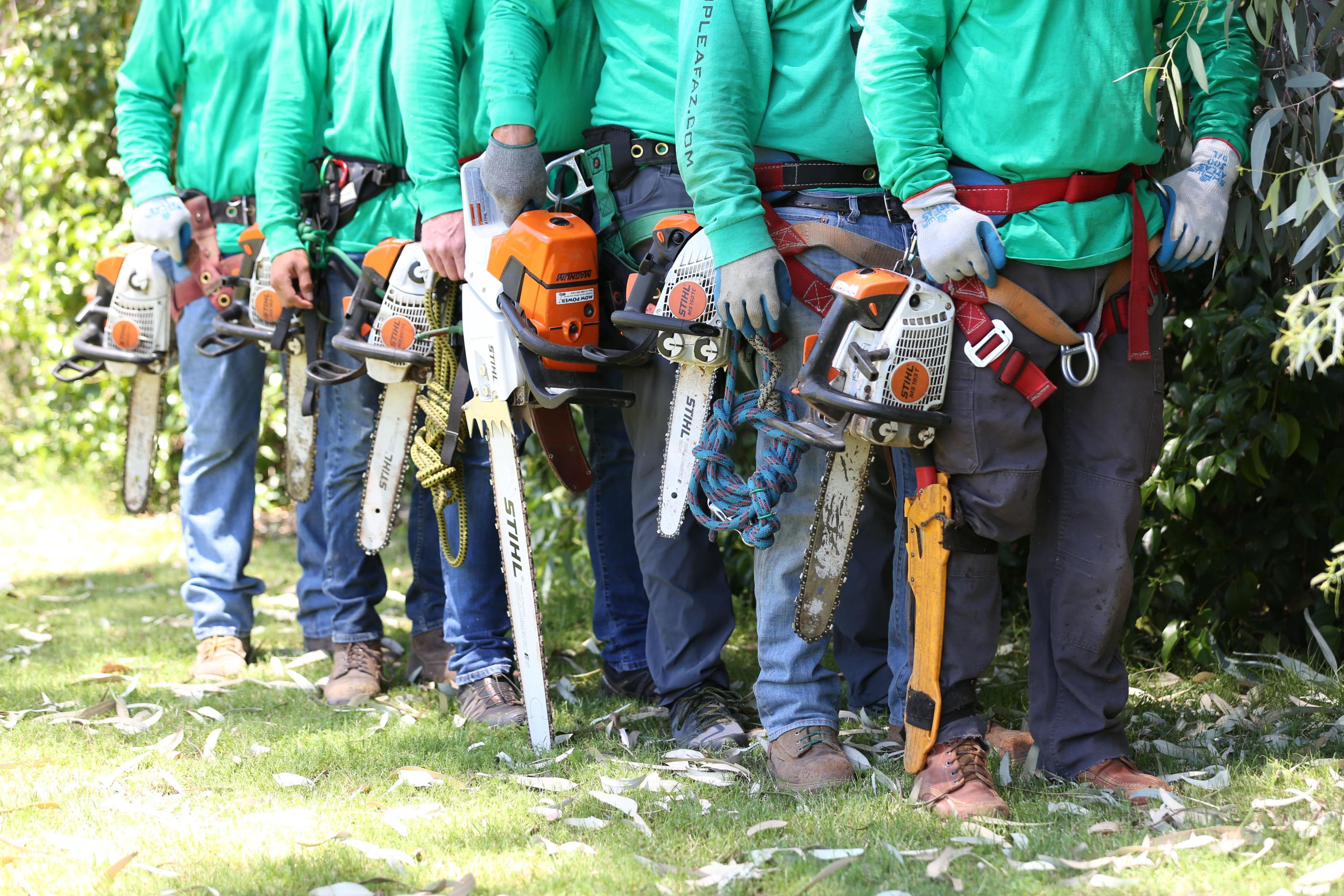
We provide top-rated tree removal in Queen Creek, AZ, keeping homes safe and families worry-free.
Top Leaf Tree Service offers a full range of services, including tree trimming, ensuring glittering streets and sparkling peace of mind. Let us protect your yard together.
Cracked Trunk Detection
Problem: Undetected trunk fissures compromise structural integrity, increasing failure risk during wind events (ASTM F2215‑20).
Solution: Deploy ISA‑certified arborists to perform visual inspection, ultrasonic tomography, and resistograph testing.
-
Visual cue: longitudinal crack > 2 mm in width, > 10 % of stem diameter.
-
Ultrasonic velocity loss > 15 % vs. baseline indicates internal decay (ISO 13374‑1).
-
A Resistograph resistance spike of > 30 % flags wood density reduction.
Compliance: OSHA 1926.701 for safe removal procedures. Additionally, understanding deadly tree removal hazards is essential for ensuring safety during the removal process.
Isa‑Certified Wind‑Risk Assessment
Problem: Wind‑Risk Quantification
Tree removal in Queen Creek must account for wind‑induced failureISA‑certified arborists apply the American Society of Civil Engineers (ASCE) 7‑16wind‑speed maps (3‑second gust, 90‑yr return period) and ASTM E-330bending‑stress tests to compute critical load (Pₙ).
Solution: Certified Assessment Protocol
-
Site Survey – Measure exposure category (C‑D) and topographic factor (Kₜ).
-
Tree Metrics – Record DBH, height, crown width, and root spread.
-
Load Calculation – Pₙ = 0.5 × C_d × ρ × A × V² (C_d = 0.25 for conifers, ρ = 1.225 kg/m³, A = projected area, V = design wind speed).
-
Safety Factor – Apply ISA‑recommended factor of 1.5; if Pₙ < 1.5 × actual load, schedule removal.
Outcome
Quantitative wind-risk scores enable precise, ISA‑compliant removal decisions, reducing liability and preserving property integrity.
Problem: Wind‑Induced Failure Risk in Queen Creek, AZ
Wind speed design for a 100-year return period indicates gusts of approximately 85 mph, as per ASCE 7-22, Table 3-1. The tree species identified include Saguaro, Palo Verde, and Mesquite, characterized by an average trunk diameter of about 30 inches and a root spread estimated at three times the diameter at breast height (DBH).
The soil condition is classified as loamy sand, with a bearing capacity of approximately 1.5 MPa according to ASTM D 2487.
Solution: ISA‑Certified Wind‑Risk Analysis Protocol
-
Structural Assessment: Compute overturning moment (M) = C · A · V² · h, where C = 0.5 (empirical), A = projected area (ft²), V = wind speed (ft/s), h = center‑of‑gravity height (ft).
-
Root Anchorage: Verify root‑soil shear resistance ≥ M using a factor of safety ≥ 1.5 (OSHA 1910‑147).
-
Health Check: Apply ISA‑standard canopy density index ≤ 0.6 for removal eligibility.
Outcome Metrics
-
Risk Score: (M / root resistance) × (1 – canopy index).
-
Threshold: Score > 1.0 triggers removal or reinforcement.
Compliance
-
ISA Certified Arborists: Todd Hansen, Jason Klug, Leo Coronado, Brandon Dawson.
-
Licensing: Arizona State Contractor License #123456; insured for $5M.
Result: Trees exceeding the risk threshold are scheduled for removal, ensuring safety and compliance with ASCE 7‑22, ASTM D 2487, and OSHA standards.
Get Your Free Tree Removal Estimate Today!
Trusted for tree fertilization and more, Top Leaf Tree Service delivers expert care you can count on.
Ready for a free, no‑obligation estimate? Call us at 480‑933‑2909, email office@topleafaz.com, or visit our contact page, Top Leaf Tree Service.
See why our clients rave about us on SoTellUs.
Queen Creek, AZ: Attractions and Landmarks
Queen Creek’s charm shines through its blend of history and outdoor fun, inviting families and enthusiasts alike.
-
Historic Downtown – shops, cafés, and a museum with seasonal events.
-
Creekside Trail – a walking path with shaded benches, perfect for tree pruning demos.
-
Desert Garden – native plants, tree-planting services for shade, and emergency storm-damage crews on standby.
Get Started
Fill out form below