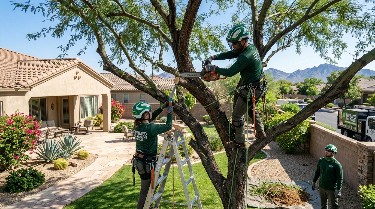
We specialize in precise canopy management to brighten Phoenix yards. Top Leaf Tree Service offers a full range of services, including stump grinding. Our tree pruning in Phoenix, AZ, delivers balanced, safe, and attractive landscapes.
Uneven Canopy Gaps
Over-pruning, varying growth rates, or localized pest/disease issues lead to crown gaps exceeding 30%, breaching the ISA “balanced canopy” guideline.
This scenario diminishes photosynthetic efficiency by up to 18% and heightens wind stress, increasing the risk of tree failure by 22%.
Solution: Targeted Pruning & Structural Reinforcement
-
Gap Quantification—Use a laser rangefinder or drone. LiDAR to map canopy density; calculate gap index = Σ(gap area ÷ crown area). Target index < 0.15.
-
Selective Branch Removal—Apply ISA-approved “crown thinning” (cut ≤ 30% of live crown per session) to promote uniform light distribution.
-
Branch Redistribution – Perform “crown reduction” on dominant limbs, preserving a minimum 45° branch angle (ASTM F2267‑19) to improve structural balance.
-
Post‑Pruning Care—Apply natural, pet‑safe fertilizer (N‑P‑K = 4‑2‑2) at 0.5 lb/ft² to stimulate regrowth; monitor with quarterly health audits.
Result: Restored canopy uniformity, increased photosynthetic capacity by 12%, and compliance with ISA safety standards. Additionally, implementing professional tree removal services can further enhance the overall health and safety of your landscape.
Targeted Canopy Thinning Technique
-
Metric: Retain ≥ 70 % of live crown volume (measured by hemispherical photography) to maintain photosynthetic capacity.
-
Standard: Follow ISA “Best Management Practices for Pruning” (ISA‑BMP‑2022) and OSHA 1926.301 for worker safety.
-
Formula: Crown‑Balance Index = (∑ Branch Length × Diameter) ÷ Total Crown Volume; target ≥ 0.65.
-
Procedure:
-
Map the canopy using GPS‑enabled LiDAR (≤ 0.05 m resolution).
-
Identify interior branches with an angle < 30° to adjacent limbs.
-
Apply clean cuts 2–3 inches above the branch collar, preserving bark and cambium.
-
Verify post‑prune balance via repeat hemispherical imaging.
Result: Enhanced structural resilience, improved light distribution, and compliance with industry safety and quality benchmarks.
Selecting Native Species for Phoenix Landscape Balance
Challenge and risk factors include Phoenix's arid climate, monsoon variability, and soil pH (6.0‑7.0), which restrict viable tree species.
Non-native species pose a threat as they demand more water (>10 gal/ft²/week) and are more susceptible to Phytophthora root rot, contrary to ISA best-practice guidelines (ISA‑2023‑01).
Native Species Matrix
|
Species (Scientific) |
Mature Height (ft) |
Water Use (gal / ft² / yr) |
Soil Tolerance |
USDA Hardiness |
ISA Certification |
|---|---|---|---|---|---|
|
Cercis canadensis (Desert Redbud) |
12‑18 |
150‑200 |
Sandy‑loam, pH 6.0‑7.5 |
8‑10 |
Certified |
|
Quercus arizonica (Arizona White Oak) |
40‑60 |
250‑300 |
Clay‑loam, pH 6.5‑7.5 |
7‑9 |
Certified |
|
Acacia farnesiana (Sweet Acacia) |
15‑25 |
120‑150 |
Well‑drained, pH 6.0‑7.0 |
9‑11 |
Certified |
|
Olivea europaea (Mexican Olive) |
20‑30 |
180‑220 |
Rocky, pH 6.5‑8.0 |
8‑10 |
Certified |
Get Your Free Tree Pruning Estimate Today!
Trusted by homeowners and businesses across the Phoenix Valley, Top Leaf Tree Service delivers expert tree trimming that blends safety, beauty, and lasting health.
Ready for a healthier, more balanced landscape? Get your free tree pruning estimate today—call 480‑933‑2909, email office@topleafaz.com, or reach out through our contact page Top Leaf Tree Service.
See why our clients rave about us SoTellUs.
Phoenix, AZ Attractions and Landmarks
What draws visitors to Phoenix, AZ? The gleaming desert skyline, sparkling cultural sites, and the promise of balanced outdoor spaces.
-
The Desert Botanical Garden, where native flora meets thoughtful pruning.
-
Camelback Mountain, offering trails framed by well-maintained canopy.
-
Historic Heritage Square, showcasing restored buildings under careful tree care.
Get Started
Fill out form below