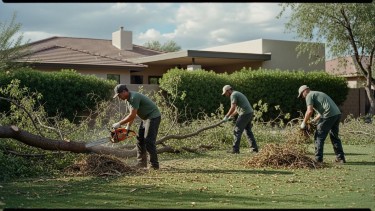
We provide expert arborist services for homeowners and businesses across Scottsdale. Our Emergency Storm Damage Removal in Scottsdale, AZ safely eliminates hazardous limbs threatening your property.
Top Leaf Tree Service offer a full range of services including stump grinding. We use certified crews, advanced rigging techniques, and structural analysis to ensure safety and tree health.
Overhanging Limb Risk Indicators
Structural failure in aerial limbs occurs when decay, biomechanical stress, or environmental loading exceeds wood integrity thresholds. Critical assessment parameters include:
Failure Mechanics
-
Radial checks and longitudinal splits indicate tension wood failure or drying stress concentration.
-
Cavitation from pathogenic colonization (fungal decay, canker expansion) reduces load-bearing capacity.
-
Cambial damage and exposed sapwood accelerate decomposition rates.
Hazard Evaluation
-
Crown asymmetry or directional lean signals root anchorage compromise or uneven mass distribution.
-
Soil subsidence and crown exposure indicate shallow rooting or erosion.
-
Post-storm weight increase combined with pest susceptibility accelerates structural degradation.
Intervention Priority
Hazard mitigation requires professional arboricultural assessment. Understanding local climate challenges is crucial for effective tree maintenance and risk assessment.
Early intervention prevents catastrophic failure affecting property, infrastructure, and human safety.
Rapid Limb-Extraction Protocol
Licensed arborists conduct structural analysis identifying failure points, load vectors, and proximity hazards. Triage prioritizes branches exhibiting signs of codominant stems, included bark, or storm damage creating asymmetric weight distribution.
Rigging systems employ tension calculations and directional felling to isolate target limbs from structures. Staged sectioning reduces momentum transfer.
Remediation & Resilience
Post-extraction assessment includes canopy density evaluation, apical dominance restoration, and wound dressing protocols.
Crown thinning reduces wind-loading coefficients, improving aerodynamic stability. Follow-up arboriculture addresses physiological stress and disease vectors through targeted fertilization and phytosanitary monitoring.
Isa-Certified Arborists First-Rate Safety
Risk Assessment & Engineering Controls
ISA-certified arborists employ load-path analysis to quantify force distribution through branch structures and rigging systems.
Personal Protective Equipment Compliance
PPE requirements include hard hats rated for impact and penetration, climbing harnesses meeting ANSI Z359.12 standards, and eye protection for debris projection hazards. Equipment inspection protocols establish maximum service intervals before retirement.
Hazard-Specific Protocols
Operations near energized conductors require de-energization verification or minimum 10-foot clearances per OSHA guidelines.
Post-storm debris removal prioritizes structural stability assessment before limb severance. Dead-wooding and crown thinning reduce wind-load stress through biomechanical analysis of remaining canopy architecture.
Operational Disciplines
Knot specifications (bowline, clove hitch, figure-eight) distribute load stress across rope cross-sections.
Pre-operation equipment checks verify rigging integrity, communication systems, and crew positioning relative to drop zones.
Get A Free Emergency Storm Damage Assessment & Tree Care Quote Today!
Storm damage compromises structural integrity through branch failure, canopy imbalance, and root system disruption. ISA-certified arborists diagnose damage severity using resistance measurements and visual branch collar assessment to determine retention versus removal.
Critical Tree Health Indicators
Bark stripping, cambium exposure, and crown fractures signal intervention urgency. Palm species require species-specific assessment; frond damage differs from structural compromise requiring different mitigation strategies.
Service Scope
Removal, pruning, and health restoration address immediate hazards and long-term vitality. Complimentary health diagnostics quantify pathogen presence, nutrient deficiency, and biomechanical stress.
Contact Information
Phone: 480-933-2909
Email: office@topleafaz.com
Web Contact Page: Contact Us Here
Customer Reviews:
Scottsdale, Arizona: Desert Infrastructure and Landscape Resilience
Scottsdale's attractions operate within the Sonoran Desert climate zone, characterized by monsoon precipitation events (June-September) and extreme thermal conditions.
The region's landscape maintenance infrastructure addresses specific environmental stressors: arboricultural management during storm events.
Professional arboricultural services manage post-monsoon damage through emergency response crews specializing in fallen limb removal and storm debris clearance.
Native American heritage sites and modern galleries require specialized landscape preservation reflecting both ecological adaptation and cultural preservation standards.
Get Started
Fill out form below