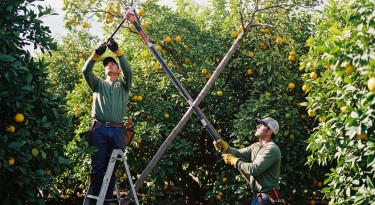
At Top Leaf Tree Service, we bring over 20 years of ISA-certified expertise to enhance the health and beauty of your trees. Our team specializes in desert-safe arboriculture, focusing on our ANSI A300 Crown Reduction Workflow in Tree Trimming to optimize canopy ventilation.
We carefully thin crowded branches, remove crossing limbs, and open airflow channels to reduce stress, boost light penetration, and improve resilience.
Our comprehensive services include professional trimming, crown shaping, and tree fertilization, ensuring your trees thrive and your property remains attractive.
Key Takeaways
-
Optimized canopy ventilation reduces tree stress and promotes healthier growth in Phoenix’s dry climate.
-
Professional trimming improves light penetration to inner branches, boosting overall tree vitality.
-
Enhanced airflow through the canopy increases storm resilience against Arizona’s monsoon winds.
-
Balanced crown structure from pruning extends tree longevity and enhances property aesthetics.
-
Seasonal trimming schedules align with local climate to ensure optimal canopy health year-round.
Tree Trimming: Auxin-Cytokinin Canopy Physiology Science
Auxin-to-cytokinin ratios dictate apical dominance and lateral bud suppression. Crown thinning reduces terminal auxin production, increasing cytokinin translocation to remaining buds.
Deadwood removal eliminates non-conductive xylem, preserving phloem transport efficiency without altering auxin gradients.
This process lowers wind-load transpiration stress, maintaining leaf-area-to-root-mass equilibrium at ≤25% foliage removal per ANSI A300.
Not only that, proper pruning techniques foster healthier tree growth and reduce the risk of fire hazards in urban settings.
Tree Trimming ANSI A300 Crown Reduction Workflow
Crown reduction prescriptions target live branch retention to maintain auxin/cytokinin gradients and apical dominance.
ANSI A300 demands final cuts at lateral branches ≥1/3 the diameter of the removed limb, preserving the branch bark ridge to prevent xylem desiccation.
Reduction cut diameter shall not exceed 3 inches for any single pruning cut to optimize woundwood compartmentalization.
Maximum live crown removal is capped at 25% per ANSI A300. Not only that, proper disposal of debris is essential to ensure a safe environment during and after the tree trimming process.
ANSI A300 Compliance for Tree Trimming
ANSI A300 compliance for canopy ventilation optimization in Phoenix, AZ requires verification of reduction-cut placement at a maximum of 25% of live crown volume to prevent auxin-cytokinin gradient disruption.
Local jurisdictional compliance is confirmed via municipal code 14-3-10(c), mandating that all cuts terminate at a lateral branch ≥1/3 the diameter of the parent stem to preserve bark ridge integrity.
Local Phoenix, AZ Events & Attractions
-
The Desert Botanical Garden showcases over 50,000 arid-climate plants across 140 acres at 1201 N Galvin Parkway.
-
Camelback Mountain’s 2.5-mile Echo Canyon Trail ascends 1,280 vertical feet through ancient Precambrian granite formations.
-
Pueblo Grande Museum protects 1,500-year-old Hohokam platform mounds and a replicated ballcourt at 4619 E Washington Street.
-
Papago Park’s 296-foot Hole-in-the-Rock sandstone butte offers a 360-degree view of the valley floor at 625 N Galvin Parkway.
Estimates for Tree Trimming in Phoenix, AZ
Auxin/cytokinin gradient disruption via excessive pruning constitutes a primary failure mode for Phoenix Valley palo verde and mesquite specimens. Top Leaf Tree Service’s ISA Certified Arborists—Todd Hansen, Jason Klug, Leo Coronado, and Brandon Dawson—apply ANSI A300-compliant crown thinning (≤25%) and bark ridge preservation to maintain xylem/phloem integrity and apical dominance.
Contact Top Leaf Tree Service at 480-933-2909 or office@topleafaz.com for an on-site estimate, with a 10% discount on palm tree trimming services booked within 14 days of quote validation.
Verified client outcomes from SoTellUs document reduced transpiration stress and improved structural soundness in adjacent residential canopies, confirming adherence to ANSI Z133 safety protocols and OSHA 1910.269 utility clearance (10-ft minimum).
480-933-2909
Get Started
Fill out form below