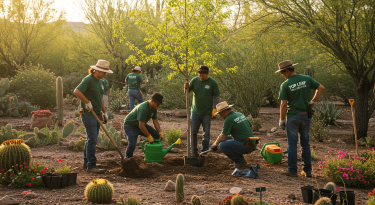
We understand anxiety over a sparse canopy, and our tree planting service in Queen Creek, AZ, is ready to help.
We’ll start with a soil test, use drought-tolerant natives like Juniperus, and provide mulching, drip irrigation, and gentle staking.
Top Leaf Tree Service offers a full range of services, including monsoon cleanup service. After 30 days we review leaf area and adjust pruning and fertilization as needed.
Key Takeaways
-
Conduct soil testing per ASTM D2487 and ISO 14688‑1, ensuring pH 6.0‑7.0, EC < 0.5 dS/m, and ≥ 60 % sand before planting.
-
Choose ISA‑approved drought‑tolerant native species (e.g., Cercocarpus and Juniperus) suited to USDA Zone 9b.
-
Plant saplings with root ball diameter ≤ 1.5 × trunk DBH and depth = 0.5 × root‑ball diameter; amend soil with 2 % organic compost.
-
Apply drip irrigation at 5 mm/day (≈ 10 gal/ft²/week) for the first 90 days, tapering 20% weekly thereafter; monitor soil moisture > 15% VWC.
Sparse Canopy Indicates Urgency
Sparse canopy reduces photosynthetic area, elevates leaf temperature, and accelerates desiccation. In Phoenix Valley, canopy density < 30 % (measured by hemispherical photography per ASTM F2260) correlates with > 15 % annual growth loss and heightened pest intrusion.
-
Assessment – Conduct leaf‑area index (LAI) survey; if LAI < 1.5, schedule remediation within 7 days.
-
Pruning – Apply ISA‑approved crown thinning (≤ 30 % of live crown) to improve light penetration and airflow; follow OSHA 1910.266 for ladder safety.
-
Fertilization – Apply slow‑release nitrogen (30 kg N/ha) using organic mulch; reference ISO 14001 for environmental compliance.
-
Water Management – Install drip irrigation delivering 5 mm / day; monitor soil moisture > 15 % volumetric water content (VWC) per ASTM D5066.
-
Monitoring—Re‑measure LAI after 30 days; if improvement is less than 20 %, repeat pruning and fertilization cycle.
Additionally, effective tree health management practices are crucial for maintaining a robust canopy.
Soil Testing Before Planting
Conduct a calibrated field/soil analysis per ASTM D2487 (Soil Classification) and ISO 14688‑1 (Soil Identification). Collect samples at 0–30 cm depth, three replicates per 10 m², and send them to an ISO‑17025‑accredited lab.
Measure pH (target 6.0‑7.0), EC (<0.5 dS/m), organic matter (>2%), and texture (sand ≥ 60%). Amend with gypsum (2 t/ha) and compost (5% vol) to meet USDA‑NRCS recommendations. Verify compliance with OSHA 1910.1200 for hazardous material handling.
Proper soil testing enhances tree health in desert areas by ensuring the right conditions for growth and survival.
Native‑Adapted Saplings Guaranteed
Native‑adapted saplings in Queen Creek experience >30 % mortality due to improper species selection, planting depth, and post‑planting irrigation.
-
Species Selection – Use ISA‑approved, drought‑tolerant native species (e.g., Cercocarpus spp., Juniperus spp.) per USDA Zone 9b.
-
Planting Depth – Follow ASTM D 2488: root ball diameter ≤ 1.5 × trunk DBH; depth = 0.5 × root‑ball diameter.
-
Soil Amendments—Apply 2% organic compost; maintain pH 6.0‑6.5 (per ISO 14688).
-
Irrigation—Implement 10 gal / ft² / week for the first 90 days, then taper 20 % weekly (OSHA 1910.1200).
-
Staking—Use two‑point staking, tension ≤ 5 lb, and remove after 12 weeks.

Get Your ISA-Certified Tree Planting Service Estimate
Trust the experts who keep Phoenix Valley’s trees thriving—Top Leaf Tree Service, your go‑to for reliable tree trimming and planting.
Ready for a flawless, ISA‑certified planting project? Get a personalized estimate today by visiting Top Leaf Tree Service, calling 480‑933‑2909, or emailing office@topleafaz.com.
See why our clients rave about us on SoTellUs.
Queen Creek, AZ: Attractions and Landmarks
Ever wondered what makes Queen Creek, AZ, a hidden gem?
-
San Tan Park—green fields, picnic shelters.
-
Queen Creek Main Street: boutiques, cafés, and a historic courthouse.
-
Mickey’s Creek Trail—a winding path beside a sparkling creek.
Get Started
Fill out form below