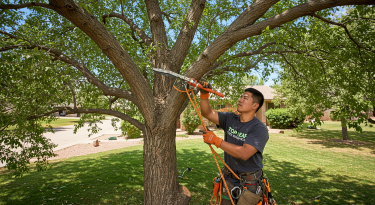
We specialize in professional citrus tree management throughout Scottsdale. Our Tree Pruning in Scottsdale, AZ focuses on removing crossed branches to reduce mechanical stress and optimize canopy structure.
Top Leaf Tree Service offer a full range of services including tree planting. We remove limbs with acute angles while preserving scaffold limbs, utilizing ISA-certified practices and root-zone assessments for targeted thinning and nutrient adjustments.
Sudden Fruit Drop: Physiological Stress Indicators
Premature fruit abscission signals acute environmental or physiological dysfunction requiring diagnostic intervention.
Root-zone moisture deficits, nutrient imbalances (particularly potassium and magnesium), pest pressure, and excessive fruit load trigger abscission layer formation, accelerating fruit separation.
Diagnostic Protocol
Root System Assessment: Evaluate soil saturation, compaction, and pathogenic colonization affecting water and nutrient uptake capacity.
Canopy Analysis: Quantify fruit load relative to leaf area ratio; excessive fruit-to-foliage ratios exceed photosynthetic capacity, triggering selective abscission.
Pest and Disease Evaluation: Screen for mite populations, fungal infections, and scale infestations causing vascular compromise.
Corrective Interventions
Working with a certified arborist ensures interventions align with tree vigor recovery trajectories and prevents secondary decline progression.
Citrus Crossed-Branch Removal Protocol
Branch intersection assessment determines removal priority through angle measurement and diameter ratio analysis. Load-bearing capacity diminishes at acute angles (<45°), creating mechanical stress concentration points requiring targeted intervention.
Selective removal targets competing limbs exhibiting inverse growth vectors or collar compression. Preservation of primary scaffold maintains apical dominance and vascular continuity.
Post-removal structural monitoring documents wound closure rates, cambial response, and secondary branch development.
Photosynthetic redistribution patterns and canopy architecture restoration require 12-month assessment intervals to evaluate long-term mechanical stability and fruit-bearing capacity alignment with orchard productivity standards.
ISA-Certified Arboricultural Standards
ISA certification establishes evidence-based protocols for tree health management through systematic assessment and intervention.
Root collar excavation and soil chemistry analysis determine nutrient deficiencies and compaction stress.
Phenologically-timed pruning cycles—dormant season for deciduous species, selective reduction for palms—remove deadwood, reduce wind-loading, and restore apical dominance.
Structural risk assessment identifies hazard trees requiring removal or cable-bracing systems.
Fertilization applications address specific nutrient pathways: nitrogen for foliar development, phosphorus for root architecture, potassium for disease resistance and drought tolerance.
Integrated monitoring protocols track cambial health, crown dieback progression, and pest pressure.
Commercial properties benefit from standardized maintenance schedules; residential canopy management balances aesthetic form with structural integrity and environmental services.
Stump Grinding & Tree Pruning Services
Stump grinding eliminates subsurface root systems that compromise soil stability and landscape aesthetics. Top Leaf Tree Service employs mechanized grinding equipment to reduce stumps below grade level, preventing regrowth and facilitating replanting.
Pruning Methodology
ISA-certified arborists execute structural pruning to enhance apical dominance, improve canopy architecture, and reduce disease vectors. Selective branch removal increases light penetration and air circulation, mitigating fungal pathogens.
Health Assessment Protocol
Complimentary arboricultural evaluations identify structural defects, pest pressure, and nutrient deficiencies. Early intervention prevents advanced decay and extends tree longevity.
Contact & Scheduling
480-933-2909 | office@topleafaz.com or Contact Top Leaf today here.
Scottsdale, Arizona: Landscape and Urban Infrastructure
Scottsdale integrates desert ecology with municipal design through three primary systems: native habitat preservation along riparian corridors and bajada terrain; architectural planning reflecting Sonoran climate adaptation; and cultural institutions documenting regional settlement patterns.
Arboricultural Management Framework
Desert vegetation requires species-specific maintenance protocols. Native specimens (Palo verde, mesquite, acacia) demand deep-root fertilization cycles aligned with monsoon precipitation patterns.
Storm damage assessment following convective events necessitates certified arborist evaluation for structural integrity and liability documentation.
Pruning specifications vary by species phenology and urban interface proximity, with senior populations benefiting from cost-adjusted service models for risk mitigation on residential properties.
Get Started
Fill out form below