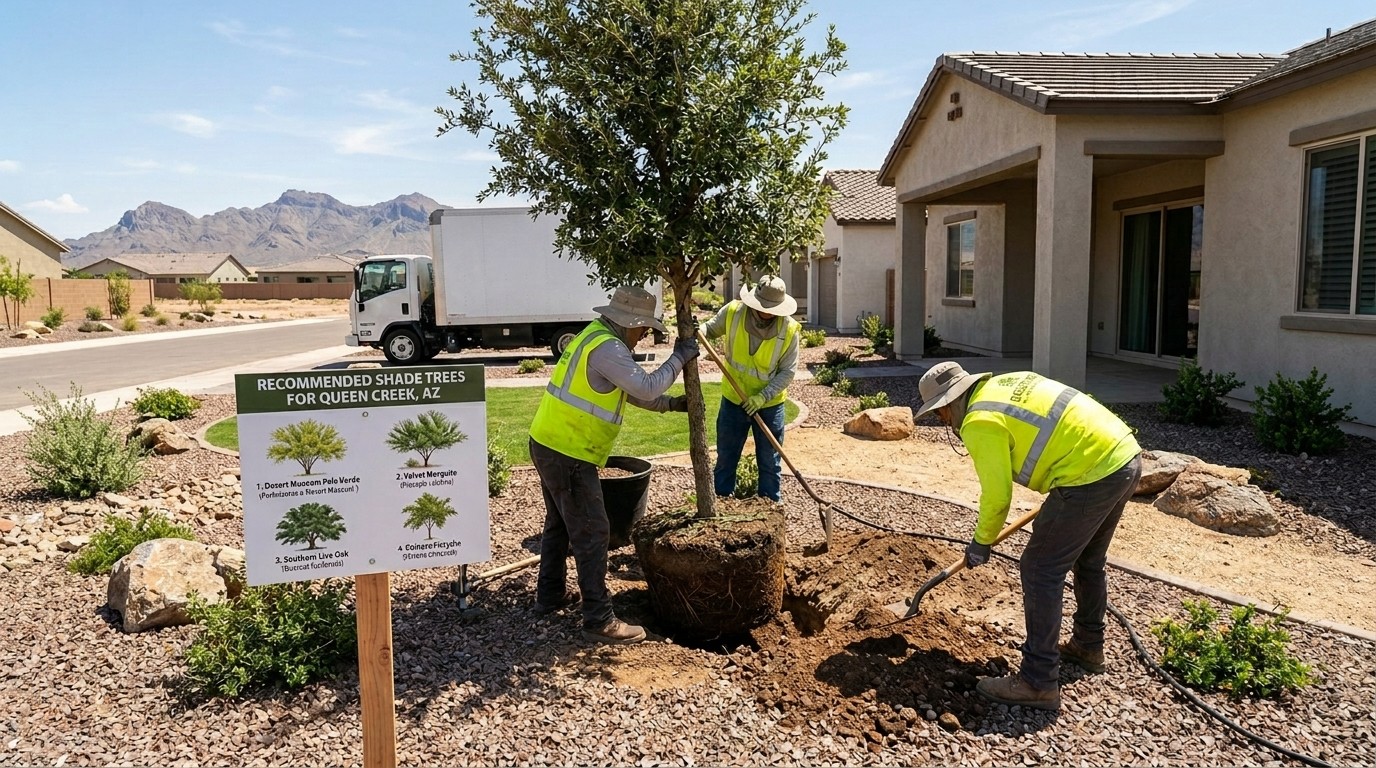
We’ve spotted the shade-need signs in Queen Creek: leaf scorch, hot leaves, and thin crowns. Our tree planting in Queen Creek, AZ, focuses on native giants like Live Oak, Arizona Ash, and Desert Willow, spaced 10–12 ft apart.
Top Leaf Tree Service offers a full range of services, including monsoon cleanup service. A certified arborist will check soil pH, drainage, and dust compliance, ensuring roots thrive and temperatures drop.
Key Takeaways
-
Choose native, high-canopy species like live oak (Quercus virginiana), Arizona ash (Fraxinus velutina), and desert willow (Chilopsis linearis) for optimal shade in Queen Creek’s Zone 9b.
-
Ensure site preparation: 20 ft clearance from structures, soil pH 5.5–7.0, drainage class A‑C, and amend with 2–3 in organic compost.
-
Implement a watering regime of 10–15 gal/ft² weekly for six weeks, then 1–2 gal/ft² monthly during dry periods, with 3–4 in mulch kept 6 in from trunks.
-
Use a two‑stake system with flexible ties, removing stakes after 12‑18 months, and schedule regular ISA‑certified arborist assessments for canopy health and storm‑debris management.
Shade‑Need Warning Signs
-
Excessive leaf scorch (>30 % chlorosis) indicates insufficient photosynthetic output.
-
Reduced crown density below 60 % canopy coverage compromises thermal regulation.
-
Root girdling observed in 2–4 % of mature specimens accelerates water stress.
-
Increased leaf temperature ≥5 °C above ambient, measured by infrared thermography, signals inadequate shade.
Solution: Plant native, high‑canopy species (e.g., Quercus arizonica, Platanus wrightii) at 10–12 ft spacing to achieve ≥75% canopy cover within 5 years, complying with ISA best‑practice guidelines.
Additionally, implementing proper pruning techniques can enhance the overall health and effectiveness of shade trees in arid environments.
Native Oak Placement Guidelines
Site selection requires a minimum clearance of 20 ft from structures, utilities, and sidewalks, with soil pH between 5.5 and 7.0 and drainage classified as A‑C according to ASTM D2487.
For spacing, maintain 30‑40 ft between canopy edges and 25‑30 ft from property lines to support mature growth, which can reach up to 60 ft.
-
Depth & Soil Preparation: Plant at same depth as nursery container; amend with 2‑3 in of organic compost; avoid compaction > 1.5 MPa (OSHA 1926.650).
-
Watering Schedule: First 6 weeks, 10‑15 gal / ft² weekly; thereafter, 1‑2 gal / ft² per month during the dry season.
Additionally, following storm debris removal strategies can help ensure a safe environment for newly planted trees.
Certified Arborists Guarantee Optimal Shade
ISA‑certified arborists assess solar exposure, wind patterns, and soil texture to select species with ≥ 75 % canopy cover within 5 years (ASTM D4809‑21).
In Queen Creek’s USDA zone 9b, optimal shade trees include live oak (Quercus virginiana), Arizona ash (Fraxinus velutina), and desert willow (Chilopsis linearis), each meeting OSHA 1910. 132 respirable dust limits during planting.
Arborists calculate planting density (≈ 4 trees per 1,000 ft²) and root‑zone preparation depth (30–45 cm) to ensure structural stability and long‑term health, delivering measurable shade reduction of 45–60 % in the first decade.

Get Your Free Tree Planting Estimate Here!
When storm damage strikes, trust the Arizona experts who’ve protected the Phoenix Valley for over 20 years—Top Leaf Tree Service.
Get your free, no‑obligation tree‑planting estimate today by calling 480‑933‑2909, emailing office@topleafaz.com, or visiting our contact page at Top Leaf Tree Service.
See why homeowners and businesses alike rave about our work at SoTellUs.
Queen Creek, AZ Attractions and Landmarks
Top Leaf Tree Service can help you plant shade, but Queen Creek offers more than just great trees.
-
Queen Creek Historic District with charming cafés
-
San Tan Mountain Regional Park, perfect for hiking
-
Pinal County Fairgrounds, lively events all year
Get Started
Fill out form below