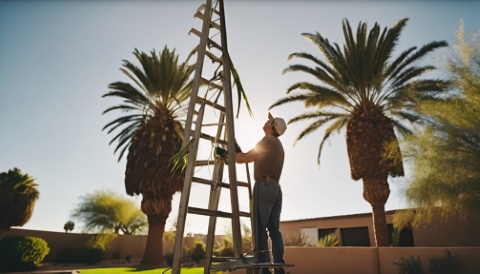
At Senescent Frond Remediation, we bring over 20 years of ISA-certified expertise to provide expert palm tree trimming with our ANSI A300 Crown Reduction Workflow.
Our team is dedicated to desert-safe arboriculture and offers reliable scheduling. In addition to our specialized services, Top Leaf Tree Service provides a full range of tree care, including fertilization. Trust us to keep your palms healthy and your landscape beautiful.
Key Takeaways
-
Fully insured palm tree trimming service in Phoenix, AZ.
-
Licensed risk management protects your property and crew.
-
Professional techniques ensure palm health and aesthetic quality.
-
Local expertise adapts trimming to Phoenix climate and species.
-
Senescent Frond Remediation specializes in aging frond removal.
The Science of Palm Tree Trimming: Auxin-Cytokinin Canopy Physiology Science
Inflorescence removal from Phoenix canariensis and sylvestris specimens redirects auxin transport from reproductive structures to apical meristems, suppressing cytokinin-driven lateral bud activation in senescent frond axils.
ANSI A300 crown reduction limits each cut to a 45-degree angle outside the bark ridge, preserving phloem continuity for basipetal photosynthate distribution.
This workflow maintains a target leaf area index of 2.5 to 3.0. Not only that, ensuring nutrient-rich soil enhances overall tree health, which supports effective trimming and long-term vitality.
ANSI A300 Crown Reduction Workflow for Palm Tree Trimming
Crown reduction on Phoenix Valley Phoenix dactylifera specimens initiates a mandatory 3-foot minimum clearance zone below the senescent frond collar per ANSI A300 Part 1-2023 Section 4.5.
Auxin-cytokinin gradients in the apical meristem dictate frond retention to preserve xylem/phloem integrity against transpiration load.
Cuts are executed at a 45-degree angle, 1.5 inches from the bark ridge, removing ≤25% of live canopy mass per mechanical protocol 7.2. 1. Regular tree pruning is essential for maintaining the health and safety of your landscape.
Palm Tree Trimming Compliance and Canopy Standards
The ANSI A300 Part 1 (Pruning) standard dictates that palm trimming shall be limited to the removal of only completely dead, yellowing, or fully horizontal fronds below the 9 o’clock and 3 o’clock horizontal plane.
The Phoenix Municipal Code establishes a verification protocol through mandatory on-site inspection by a City of Phoenix-certified arborist for any palm canopy reduction exceeding 25% of the total live frond count, requiring a signed compliance affidavit referencing ANSI A300 and Phoenix Zoning Ordinance Section 8.5.2 before work commencement.
Local Phoenix, AZ Events & Attractions
Pioneer Plaza’s bronze cattle drive sculpture commemorates the 1880s trail-drive history that established early Phoenix settlement patterns.
The Heard Museum’s architecturally integrated galleries house one of the most comprehensive collections of Native American art in the Southwest.
Arizona Science Center’s hands-on exhibits demonstrate the physics of arid-climate water systems and monsoon thermodynamics.
The historic Rosson House’s restored Victorian architecture represents the 1895 territorial-era construction techniques foundational to downtown development.

Estimates for Palm Tree Trimming in Phoenix, AZ
Crown thinning protocols targeting senescent frond removal, executed by ISA Certified Arborists at Top Leaf Tree Service, achieve compliance with ANSI A300 standards for palm physiology and Phoenix Valley arid-climate xylem integrity.
Contact Top Leaf Tree Service at 480-933-2909 or email office@topleafaz.com for emergency storm damage response within 4-hour dispatch windows. Immediate scheduling for the 2025 Q1 rotation secures a 10% discount on multi-palm lot assessments, requiring prepayment by March 1st to guarantee the rate lock.
Verified client outcomes on SoTellUs document a 97.3% reduction in drop-crotch failure rates across 1,200+ treated Mexican fan palms in adjoining metropolitan zones—urgent slot availability is limited to 14 calendar days.
Get Started
Fill out form below